1w Led Driver Circuit Lm317
If you're looking for a simple high power LED driver circuit, then it's here.Driving a high power LED is not that easy. First you've to apply proper voltage to get the maximum possible brightness and you also have to limit the current to avoid LED burn out.You might have seen other high power circuits which consists of many parts, like inductors, op-amps, different regulator IC’s, transistor feedback networks even microcontrollers.Those circuits are more efficient than this one.
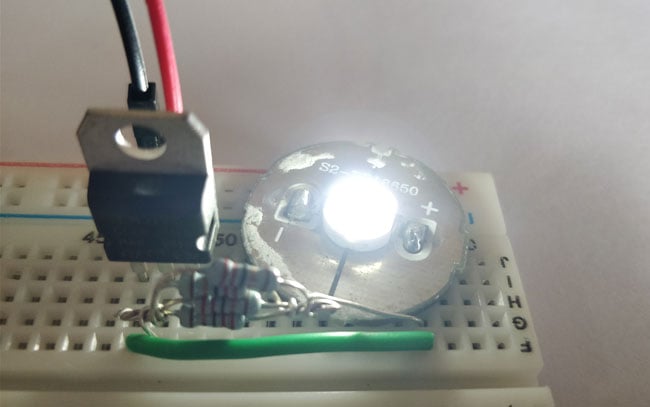
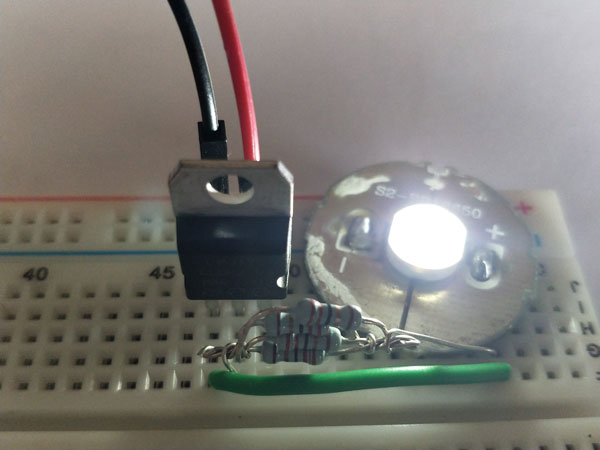
But the making expense and difficulty is much more high. So I'm showing you the simplest high power LED driver.Part list and circuit diagramIn market, we can get 1Watt and 3Watt LED easily. 1Watt LEDs have ratings of Forward Voltage 3.2V – 3.6V, and Forward Current 300mA. While the ratings of a 3 watt LED are Forward Voltage: VF 3.4V, Forward Current: 700mA.So we consider 3.4volts as optimal voltage, and thus the 1 watt LED is running at 3.4× 0.3= 1.02 watts. For a 3 watt LED it's approximately 2.38 watts.Finally here’s the simplest high power LED driver circuit diagram.Here, for a fixed reference supply, LM7805 regulator is used.
Which can deliver upto 1Amps of current. In our cases the max required current is 700ma or 0.7Amps, so no problem there. And since the resistor “R” will be eating the extra 1.6 volts(5.0-3.4). So what would be the value of R?Calculating the value of series resistor R: For the 1 watt model, there’s current of 300mA. So the value of the resistor should be 5.3 Ohms(appx) and wattage should be 0.48. Hence a 5.6Ohms 1/2 watt general purpose resistor will do the job perfectly.And similarly, for the 3 watt model, the value of R would be 2.2Ohm 1.25 watt, practically you've to choose a 2 watt resistor.You can feed any voltage greater than 5.5 volts, so we can run this circuit from a 6 volts to 12 volts supply.Wrapping upAs I've said before, this LED driver is not much efficient, you should consider a upgraded driver in your next build, which is more efficient.There's a good one,.Have any suggestion or question? Just drop a comment.Filed Under: Tagged With:.
For any LED, if the forward voltage is V1 volts and the supply is V2 volts, then the voltage across the resistor is V2-V1 volts. If the LED consumes A1 amperes of current, then by Kirchhoff's law, the same aount of current flows by the resistor.
Now, since V=IR, or R=V/I; we get resistor value by (V2-V1)/A1. And the wattage is calculated by W=VI=(V2-V1)xA1.Example: If a LED consumes 500mA at 3V, then the resistor will be (5-3)/0.5 = 4Ohms. And the wattage of the resistor will be (5-3)x0.5=1Watts.
The 3.1V is Vf @400mA so if you prevent the current going higher than that the voltage will not be able to rise higher. It's a current limiter, not a voltage limiter you need.You can use the LM317 or a fixed voltage regulator in constant current configuration but beware that the output current passes through the current limiting resistor. If you use a variable resistor make sure it can handle the current. Probably an op-amp monitoring the voltage aross a current sensing resistor would be a better solution and it makes it possible to set the current with a variable control voltage which makes it more versatile.Brian. I cut my 4 series power LEDs out of MCPCB boards with 18 in series.I drive all mine with a fixed voltage in strings of 4,6,8 depending on what surplus PSU I have and how much illumination I need as shown in Blog. & some have been running for 4 years.Can you define your thermal design and choices of power sources and min/max current you need?my concept for home of the future is central feed of 48V thruout house and Buck adjustable current boards for each application with a BOM cost about 0.5 to $2 for each.
Thus eliminating need for wallwarts. To change the brightness of an LED you are supposed to change the current, not change the voltage fed to it.The forward voltage of an LED decreases as it heats up. Then if you feed it a steady voltage its forward voltage drops which increases its current which makes it hotter which makes the current increase more which makes it hotter which makes the current increase more which makes it hotter which makes the current increase more which makes it hotter. This is called 'thermal runaway' and can destroy the LEDs.Instead you feed it a variable current to change its brightness. A current source can simply be a resistor in series with the LED. When the resistor has some voltage across it then the current does not change much when the LED heats and its forward voltage drops.
You want your paralleled 23 LEDs to have a maximum total current of 400mA so each one is about 400mA/23= 17.4mA (20mA is normal for a bright 5mm diameter LED). Then use a resistor that is about 1V/400mA= 2.5 ohms (use 2.7 ohms) rated at (400mA squared x 2.7 ohms x 2=) 1W.Feed the series resistor and LEDs a variable voltage from 2V or 3V to 4.2V.
To change the brightness of an LED you are supposed to change the current, not change the voltage fed to it.The forward voltage of an LED decreases as it heats up. Then if you feed it a steady voltage its forward voltage drops which increases its current which makes it hotter which makes the current increase more which makes it hotter which makes the current increase more which makes it hotter which makes the current increase more which makes it hotter. This is called 'thermal runaway' and can destroy the LEDs.Instead you feed it a variable current to change its brightness.
A current source can simply be a resistor in series with the LED. When the resistor has some voltage across it then the current does not change much when the LED heats and its forward voltage drops.
You want your paralleled 23 LEDs to have a maximum total current of 400mA so each one is about 400mA/23= 17.4mA (20mA is normal for a bright 5mm diameter LED). Then use a resistor that is about 1V/400mA= 2.5 ohms (use 2.7 ohms) rated at (400mA squared x 2.7 ohms x 2=) 1W.Feed the series resistor and LEDs a variable voltage from 2V or 3V to 4.2V.Thank you, this has been very helpful!So basically I can use this circuit with a series resistor at the output as you say?I think that the LM317 can be used as a current source as well, see page 12 of this datasheetBut I do not know is slow start up (a desirable feature) could be applied to it.Another idea would be to use two lm317 in series, the first as a voltage adjust and the second as a current limiter? You do not want an LM317 current limiter because a simple resistor in series with the LEDs limits the current and converts changing the voltage into changing the current.The circuit you found uses a 2k ohms trimpot. Then when the trimpot is set to halfway the output voltage from the circuit is 6.9V.
Turn it down so the voltage is about 4.2V for maximum brightness when the series resistor is 2.7 ohms.The slow turn on circuit will not immediately light the LEDs dimly but instead the LEDs will not turn on until the voltage has risen to about 2.4V, a long delay time. You probably want the LEDs to immediately light dimly then slowly get brighter. Then the transistor in the circuit must be part of a voltage divider so that the output voltage starts at about 2.4V.
Add a 220 ohms or 270 ohms resistor in series with its collector. You do not want an LM317 current limiter because a simple resistor in series with the LEDs limits the current and converts changing the voltage into changing the current.The circuit you found uses a 2k ohms trimpot.
Then when the trimpot is set to halfway the output voltage from the circuit is 6.9V. Turn it down so the voltage is about 4.2V for maximum brightness when the series resistor is 2.7 ohms.The slow turn on circuit will not immediately light the LEDs dimly but instead the LEDs will not turn on until the voltage has risen to about 2.4V, a long delay time. You probably want the LEDs to immediately light dimly then slowly get brighter. Then the transistor in the circuit must be part of a voltage divider so that the output voltage starts at about 2.4V. Add a 220 ohms or 270 ohms resistor in series with its collector.Thank you very much!I will try these points and let you know.

You do not want an LM317 current limiter because a simple resistor in series with the LEDs limits the current and converts changing the voltage into changing the current.The circuit you found uses a 2k ohms trimpot. Then when the trimpot is set to halfway the output voltage from the circuit is 6.9V.
Turn it down so the voltage is about 4.2V for maximum brightness when the series resistor is 2.7 ohms.The slow turn on circuit will not immediately light the LEDs dimly but instead the LEDs will not turn on until the voltage has risen to about 2.4V, a long delay time. You probably want the LEDs to immediately light dimly then slowly get brighter. Then the transistor in the circuit must be part of a voltage divider so that the output voltage starts at about 2.4V. Add a 220 ohms or 270 ohms resistor in series with its collector.Just to let you know, I have tested a 20R 25W wire wound resistor before the LEDs. This gives a nice smooth light variation from about 2.4v to 12v.
1w Led Driver Circuit Lm317 Switch
At 12v the TOTAL consumption (inc resistor) is 440mA and the LEDs operate as if they were operating at 3.1v, same light and heat.I like the fact that now I can use 12v without series LEDS (I do not like series leds, because if one fails, the lamp fail) and that I can vary the brightness in a smooth way.I used 25W resistor only in order not to get significant amount of heat out of it.I may now use the LM317 circuit with the changes you proposed to see if it can me smoothly start and also variable brightness. You are not applying 12V to the LEDs. Instead you are applying 12V to the 20 ohm resistor in series with the LEDs so that the maximum current is 440mA.If you use a 2.7 ohm resistor in series with the LEDs and feed it enough voltage that the current is 440mA then the LEDs will be exactly as bright as when you used 20 ohms making a lot of heat and 12V.The voltage across the 2.7 ohm resistor is calculated with Ohm's Law: V= 440mA x 2.7 ohms= 1.188V.
The maximum (brightest LEDs) output of the LM317 will be the LED voltage (3.1V) plus this 1.188V= 4.288V. For the dimmest LEDs you want the output of the LM317 to be about 2.4V so the resistor in series with the voltage-control pot should be 200 ohms. For the brightest LEDs the output of the LM317 should be 4.288V so the pot should have across it (4.288V - 1.25V=) 3.04V. If you use a pot with a total resistance of (1070 ohms - 200 ohms=) 870 ohms (use a 1k ohm pot) then you will have plenty of adjustment range. You are not applying 12V to the LEDs. Instead you are applying 12V to the 20 ohm resistor in series with the LEDs so that the maximum current is 440mA.If you use a 2.7 ohm resistor in series with the LEDs and feed it enough voltage that the current is 440mA then the LEDs will be exactly as bright as when you used 20 ohms making a lot of heat and 12V.The voltage across the 2.7 ohm resistor is calculated with Ohm's Law: V= 440mA x 2.7 ohms= 1.188V.
The maximum (brightest LEDs) output of the LM317 will be the LED voltage (3.1V) plus this 1.188V= 4.288V. For the dimmest LEDs you want the output of the LM317 to be about 2.4V so the resistor in series with the voltage-control pot should be 200 ohms. For the brightest LEDs the output of the LM317 should be 4.288V so the pot should have across it (4.288V - 1.25V=) 3.04V.
30w Led Driver Circuit Diagram
If you use a pot with a total resistance of (1070 ohms - 200 ohms=) 870 ohms (use a 1k ohm pot) then you will have plenty of adjustment range.Thank you very much audioguru.Just a final question, if I do it like you say and feed the regulator with a 12v input, the regulator will also be headed up too much wouldn't it? If I do it like you say and feed the regulator with a 12v input, the regulator will also be headed up too much wouldn't it?Does 'headed up' mean heating up?Can't you simply calculate the heating power? (12V - 4.288V) x 440mA= 3.4W and a medium size heatsink is needed. The minimum input to the LM317 can be 4.288V + 1.8V= 6.088V and the heating will be 1.8V x 440mA= 0.8W and if you use the TO-220 package and the LM317 is not enclosed then no heatsink is needed. I would use a 6VDC/500mA wall-wart then the LM317 does not need a heatsink.