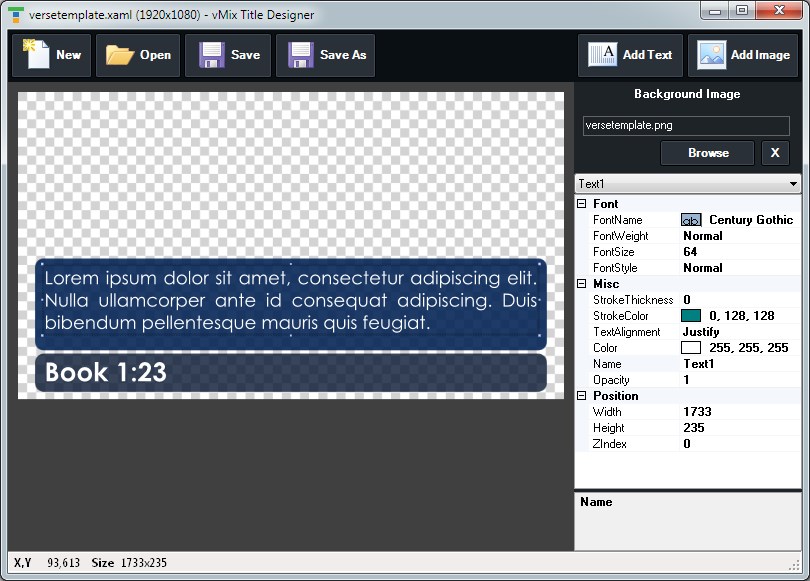
Free Xaml Designer Tool

Visual Studio 2019You can open the XAML Previewer by clicking the arrows on the split view pane. If you want to change the default split view behavior, use the Tools Options Xamarin Forms Previewer dialog. In this dialog, you can select the default document view and the split orientation.When you open a XAML file, the editor will open either full-sized or next to the previewer, based on the settings selected in the Tools Options Xamarin Forms Previewer dialog. However, the split can be changed for each file in the editor window. XAML preview controlsChoose whether you want to see your code, the XAML Previewer, or both by selecting these buttons on the split view pane. The middle button swaps what side the Previewer and your code are on:You can change whether the screen is split vertically or horizontally, or collapse one pane altogether.
Windows Presentation Foundation (WPF) is simultaneously enticing and intimidating. It offers potential for amazing flexibility in UI design but there is a mountain of learning to climb. At the time of writing I am still very much in the foothills, gazing upward. This is my second article on WPF wherein I attempt to give both you and me a “leg up” on the WPF climb from a unique perspective.
In this article I present a collection of little known but useful utility applications that can assist you as you learn and develop WPF code. You can likely infer what most of the items in Table 1 mean except perhaps for the Tools section:. A tree explorer lets you examine-bear with me here-a WPF tree. There are two types: the visual tree and the logical tree.
These both provide information on the structure of your XAML composition-see Trees in WPF for details and distinctions between the two. The command interpreter from XamlPadX lets you manipulate and inspect objects in a similar way to the Visual Studio debugger. Upon opening the command interpreter in XamlPadX, click the help icon at the lower right to get some hints on what to do. It explains things like how to inspect anonymous objects (those that you have not named) by right-clicking the object in the visual tree explorer, and how to invoke its version of Intellisense with the left Control key.

Xaml Editor
Michael Sorens is passionate about productivity, process, and quality. Besides working at a variety of companies from Fortune 500 firms to Silicon Valley startups, he enjoys spreading the seeds of good design wherever possible, having written over 100, more than a dozen, and posted in excess of 200. You can also find his open source projects on and (notably, a DB comparison tool for heterogeneous systems including SQL Server, Oracle, and MySql). Like what you have read? Connect with Michael on.